
Quarterly VAT: BIR Form 2550Q from your books
How a VAT-registered small business prepares BIR Form 2550Q: output VAT from sales, input VAT from purchases, the SLS and SLP, and the checks before filing.
On this page
A VAT-registered business files BIR Form 2550Q, the Quarterly Value-Added Tax Return, for each quarter. It reports output VAT on sales, deducts allowable input VAT on purchases, and shows the VAT payable. In PXL Books, 2550Q is filled from the sales invoices and bills you recorded, together with the Summary Lists of Sales and Purchases.
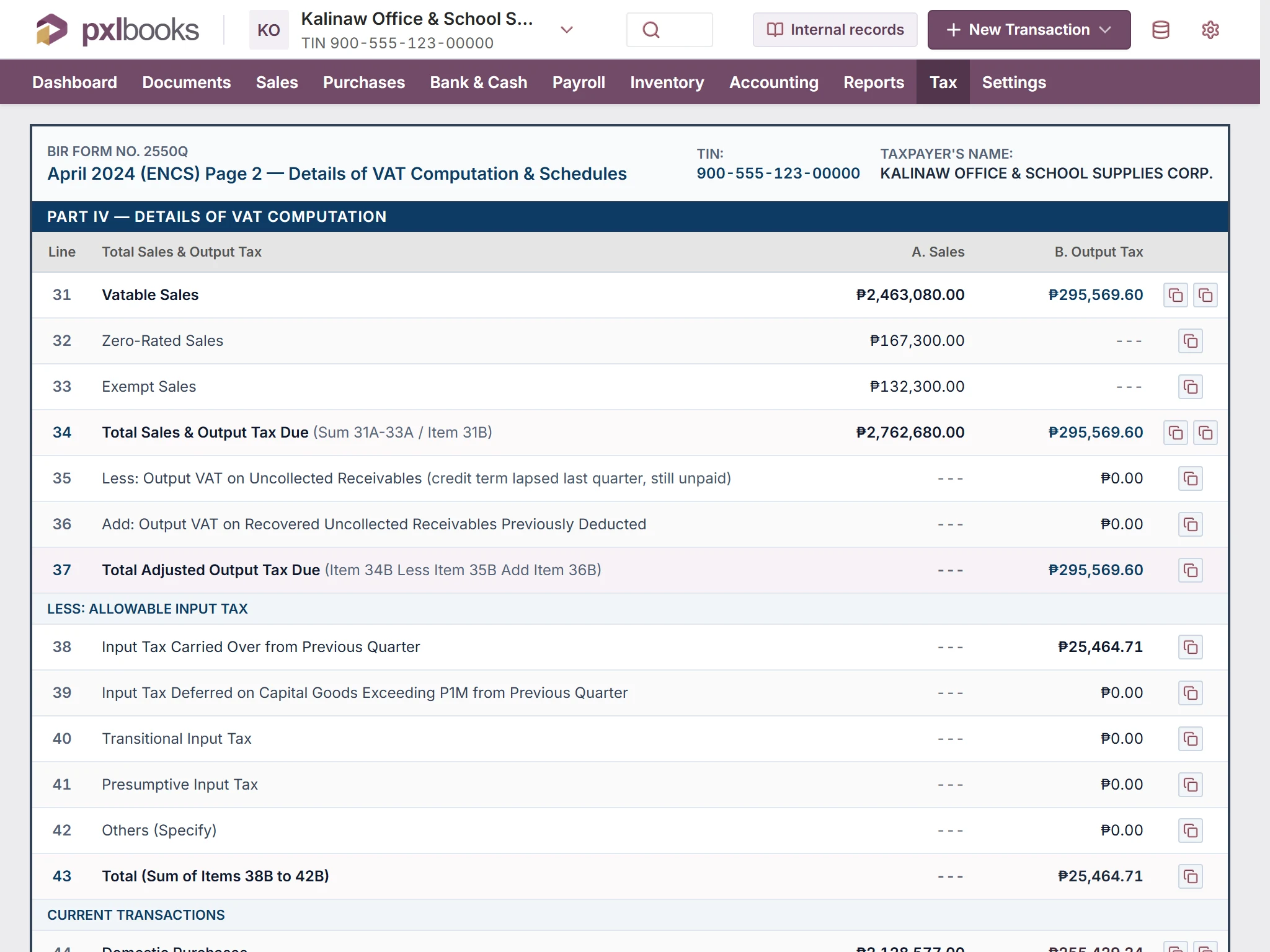
Demo records shown for illustration. Open the matching demo workflow to inspect the sample data.
The rule, in short
- VAT-registered persons file a quarterly VAT return. Since 2023, mandatory monthly VAT filing is no longer required. RMC 52-2023 permits optional monthly payments; the quarterly return remains required.
- VAT on goods and, since the EOPT Act, on services is reported on the basis of the sale, as invoiced. See EOPT in plain words.
- Input VAT is supported by the supplier's invoice.
- The Summary List of Sales (SLS) and Summary List of Purchases (SLP) are submitted for the quarter as the BIR requires.
- The statutory rate on ordinary taxable domestic sales is 12%. Form 2550Q is due within 25 days following the close of the taxable quarter, subject to applicable eFPS rules and deadline extensions. See the BIR 2550Q guidelines, April 2024.
Where each figure comes from
| On 2550Q | From |
|---|---|
| Vatable sales and output VAT | Sales invoices with a VAT tax code |
| Zero-rated and exempt sales | Sales invoices with those tax codes |
| Input VAT on domestic purchases, imports, services | Bills with a VAT tax code |
| Input VAT on capital goods | Bills for fixed assets |
| Adjustments for receivables and payables past their term (EOPT) | Unpaid invoices and bills past their term; see EOPT |
The VAT rate is set by law and kept in PXL Books under Tax Rates.
Steps
- Record the quarter completely: every sales invoice from your booklet (including cancelled numbers), every supplier bill with its invoice number, and every collection.
- Open Tax → Business Tax → VAT Return (2550Q) and choose the quarter.
- Review the form line by line. Download working paper shows the invoices and bills behind each line, in Excel.
- Check the SLS and SLP. The buyer's and supplier's TINs and registered names come from the customer and supplier records; complete any missing TIN before you submit.
- File and pay in eFPS or eBIRForms. Record the payment against Output VAT and Input VAT (PXL Books keeps the VAT accounts so the settlement can be posted).
Checks before you file
- Output VAT on the return = Output VAT in the General Ledger for the quarter, after adjustments.
- Input VAT on the return = Input VAT in the General Ledger, less any input VAT that is not creditable.
- Total sales on the return agree with the subsidiary sales journal and the SLS. See Books of accounts.
- Every booklet number of the quarter is recorded or marked cancelled (Settings → Company → Company & Tax Profile → Booklets, then Download the N not recorded).
- Service sales on account are in the quarter they were invoiced, not when they were paid.
Common mistakes
- Claiming input VAT on receipts that are not invoices, or on invoices not in your business name.
- Leaving out zero-rated or exempt sales, which still belong on the return.
- Recording a service sale only when paid, after EOPT.
- Missing TINs on the SLS or SLP.
- Mixing branch figures when a branch keeps its own books but the return is consolidated. PXL Books can show the branch figures and the consolidated total.
What stays with you
PXL Books prepares 2550Q, the SLS, the SLP and the working paper. You review them, file the return, submit the lists and pay.
Worked VAT example
An ordinary VAT-inclusive ₱11,200 sale contains ₱10,000 sales and ₱1,200 output VAT. If the period also has ₱600 allowable input VAT and no other adjustments or credits, the illustrative VAT payable is ₱600. Zero-rated, exempt, mixed-use and EOPT adjustments require separate review.
Questions
When is 2550Q normally due?
Within 25 days following the close of the taxable quarter under the BIR guidelines linked above; check eFPS rules, holidays and extensions.
Is 2550M still mandatory?
Mandatory monthly VAT filing ended from 2023. RMC 52-2023 permits optional monthly payments, but the quarterly 2550Q remains required.
Is every purchase VAT creditable?
No. Check the invoice, taxpayer status, use of the purchase and applicable input-tax rules.
Does preparing the form file it?
No. Review the return and supporting lists, then file and pay through the applicable BIR channels.
Related
- EOPT in plain words
- Recording sales from your invoice booklet
- Percentage tax: 2551Q
- Glossary: SLS, SLP, input and output VAT
Last checked against the app: November 20, 2026. Tax rules: review with your accountant.