
BIR Books of Accounts in the Philippines: Complete Guide for VAT and Non-VAT Businesses
What books of accounts are, which ones VAT and non-VAT businesses keep, how to write each, sample entries, why sales are not double-counted, and ORUS.
On this page
- What are books of accounts?
- How many books of accounts are required for VAT and non-VAT businesses?
- Types of books of accounts and their uses
- Books of original entry vs books of final entry
- How to write manual books of accounts
- Sample manual book entries for VAT and non-VAT businesses
- Sales Journal vs Subsidiary Sales Journal: Why Sales Are Not Double-Counted
- How to register books of accounts with the BIR
- Common bookkeeping mistakes
- How PXL Books keeps them
- Frequently asked questions
- Official BIR references
- Related
Books of accounts are the journals and ledgers in which a business records every transaction in date order and then sums it by account. Philippine law requires every business taxpayer to keep a relevant and appropriate set of bookkeeping records from which all transactions and taxes can be determined (Section 232(A) of the Tax Code). In practice that means journals and a General Ledger, and a VAT-registered business must also keep a Subsidiary Sales Journal and a Subsidiary Purchase Journal (RR 7-2024).
The law does not fix how many books you keep: most small businesses register four (non-VAT) or six plus the two VAT journals (VAT). A sale is written in one journal and posted to the General Ledger once, even when it also appears in the VAT journal and on the VAT return.
This guide is for business owners, bookkeepers and accounting students. It explains each book, shows the same month written for a VAT and a non-VAT business, and ends with how PXL Books prepares the books. Reviewed November 23, 2026 against the BIR issuances linked in each section. Where a rule needs your registration details, check with your accountant or Revenue District Office (RDO).
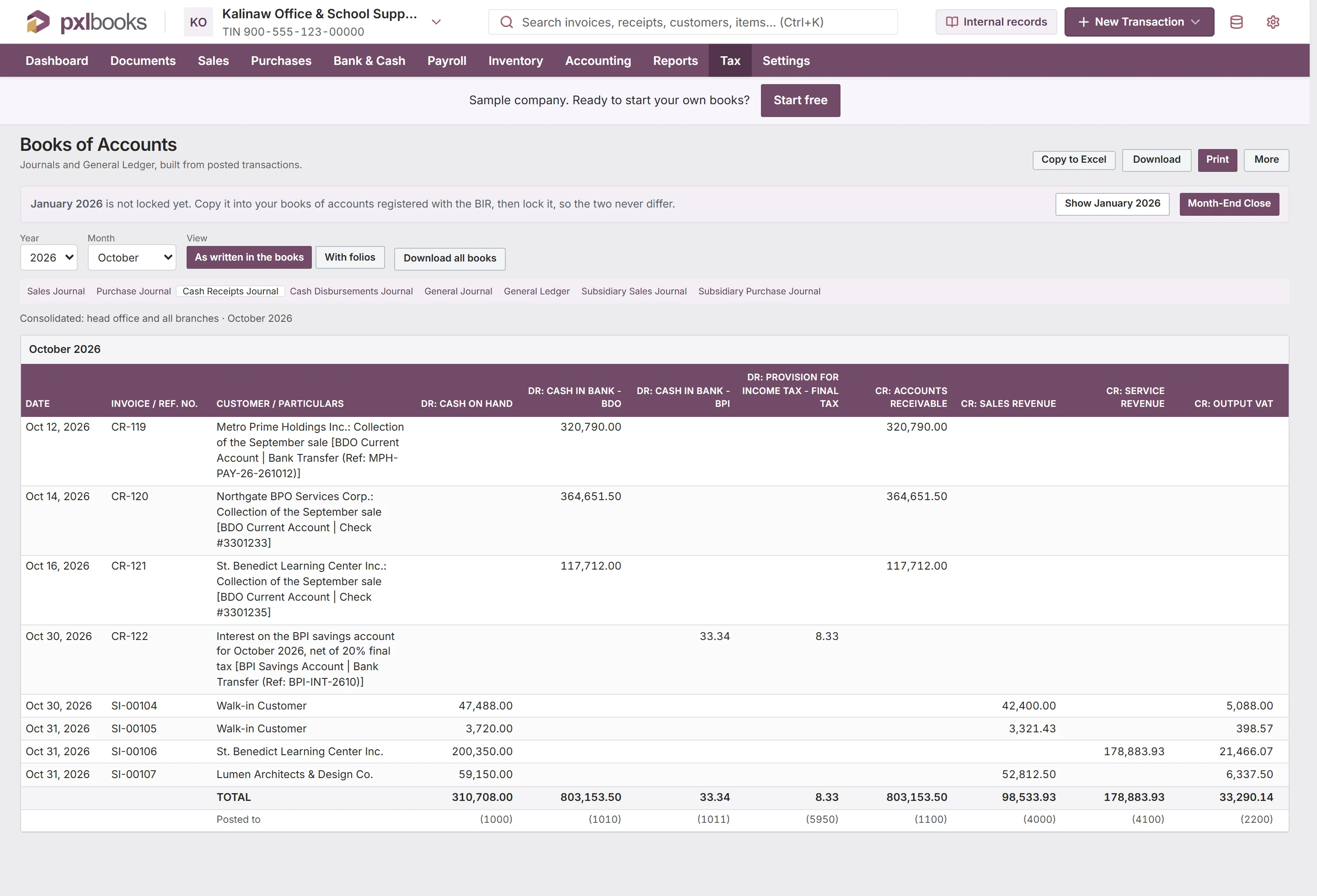
The PXL Books demo company's Cash Receipts Journal for October 2026, in the As written in the books view. Sample records.
What are books of accounts?
Books of accounts are the permanent record of a business's transactions: journals, where each transaction is first written from its source document, and a ledger, where the amounts are collected by account. The financial statements and the tax returns are prepared from them, and the BIR examines them in an audit.
Why the law requires them
- Section 232(A) of the Tax Code, as amended by the TRAIN law, requires every corporation, partnership and person required to pay internal revenue taxes to "keep and use relevant and appropriate set of bookkeeping records" in which all transactions are shown and from which the taxes due can be determined at any time (RA 10963, Section 71). A business with gross annual sales above ₱3,000,000 must also have its books audited yearly by an independent CPA.
- VAT-registered persons must also keep a Subsidiary Sales Journal and a Subsidiary Purchase Journal for their daily sales and purchases, "in addition to the regular accounting records" (RR 7-2024, Section 3(C)).
- Books are registered with the BIR before use and kept for five years (see How to register books of accounts with the BIR).
Who must keep books
| Taxpayer | What the law asks |
|---|---|
| Every corporation, partnership and person required to pay internal revenue taxes | A relevant and appropriate set of bookkeeping records showing all transactions (Section 232(A)) |
| Gross annual sales, earnings, receipts or output above ₱3,000,000 | Books audited yearly by an independent CPA, and an Account Information Form with the income tax return (Section 232(A), proviso) |
| VAT-registered persons | Also a Subsidiary Sales Journal and a Subsidiary Purchase Journal (RR 7-2024, Section 3(C)) |
Employees earning purely compensation income do not keep books. Older guides still quote the "journal and a ledger" wording and a simplified set for quarterly sales of ₱50,000 or less: both were in Section 232 before the TRAIN law took effect in 2018.
What the law requires, and what is practice
| Comes from | Examples | |
|---|---|---|
| Legal requirement | The Tax Code, revenue regulations (RR), revenue memorandum circulars (RMC), the rules on registered books and invoices | A relevant and appropriate set of bookkeeping records; the SSJ and SPJ for VAT taxpayers; registration before use; five-year retention; records kept intact |
| Bookkeeping practice | Accounting convention | Which journals you keep; a Sales Journal for credit sales only; the column headings of a Cash Receipts Journal; posting totals monthly; the folio numbering |
The layouts in this guide are practical formats. No BIR rule prescribes the exact columns. What matters legally is that every transaction and its tax details can be supported and reconciled, and that you use the book titles you registered.
Bookkeeping and accounting
Bookkeeping is recording: writing each transaction in the right book, posting it, and keeping the books balanced. Accounting goes further: choosing the accounts and policies, making adjusting entries, preparing and explaining the financial statements, and computing the taxes. A bookkeeper keeps the books; an accountant decides how they should be kept and what they say.
Double entry, debit and credit
Every transaction affects at least two accounts, and the debits always equal the credits. A debit is an entry on the left side of an account, a credit on the right. Whether a debit increases or decreases an account depends on the type of account:
| Account type | Examples | Increases with | Decreases with | Normal balance |
|---|---|---|---|---|
| Asset | Cash, Accounts Receivable, Inventory, Input VAT, Equipment | Debit | Credit | Debit |
| Liability | Accounts Payable, Output VAT, Withholding Tax Payable, Loans | Credit | Debit | Credit |
| Equity | Owner's Capital, Retained Earnings | Credit | Debit | Credit |
| Revenue | Sales, Service Revenue, Interest Income | Credit | Debit | Credit |
| Expense | Cost of Sales, Rent, Salaries, Percentage Tax | Debit | Credit | Debit |
Example: a ₱10,000 cash sale by a non-VAT seller increases Cash (an asset, debit ₱10,000) and Sales (revenue, credit ₱10,000). Debits ₱10,000 = credits ₱10,000.
How a transaction reaches the financial statements
- Source document: the invoice, receipt, voucher or bank advice that proves the transaction.
- Journal (book of original entry): the transaction in date order, with its debit and credit.
- General Ledger (book of final entry): each journal's amounts posted to their accounts, with running balances.
- Trial balance: every account's balance; total debits must equal total credits.
- Adjusting entries in the General Journal: depreciation, accruals, prepayments, corrections.
- Financial statements: the income statement from the revenue and expense accounts, the balance sheet from the asset, liability and equity accounts.
- Tax returns: VAT or percentage tax from sales and purchases, income tax from the financial statements and their tax adjustments.
How many books of accounts are required for VAT and non-VAT businesses?
The law requires a relevant and appropriate set of bookkeeping records and, for VAT taxpayers, the Subsidiary Sales and Purchase Journals. It does not fix a number of books. The sets below are what small businesses commonly register, and what PXL Books keeps for each tax type. Your accountant registers the set that fits the business, and you keep the titles you registered.
| Business | Commonly registered set |
|---|---|
| Non-VAT business | Four: General Journal, General Ledger, Cash Receipts Journal, Cash Disbursements Journal. Sales and bills on account go to the General Journal |
| VAT-registered business | Six: General Journal, General Ledger, Sales Journal, Cash Receipts Journal, Purchase Journal, Cash Disbursements Journal, plus the Subsidiary Sales Journal (SSJ) and Subsidiary Purchase Journal (SPJ) |
| Business with a branch that keeps its own books | A set for the branch and a set for the head office, with consolidated figures for the returns that are filed together |
A non-VAT business may also register a Sales Journal and a Purchase Journal if it has many transactions on account; nothing in the law forbids it.
VAT and non-VAT side by side
| VAT-registered | Non-VAT | |
|---|---|---|
| Who | Gross sales above the VAT threshold (₱3,000,000 a year, to be adjusted for inflation under the EOPT Act), or registered for VAT by choice | Below the threshold and not registered for VAT |
| Invoice | A VAT invoice for every sale, whatever the amount (RMC 77-2024) | A non-VAT invoice for each sale of ₱500 or more, whenever the buyer asks, and an end-of-day summary of smaller sales (RMC 77-2024) |
| On each sale | Output VAT, a liability (12% of the VAT-exclusive price on ordinary sales) | No VAT. Sales are recorded at the full amount |
| On each purchase | Input VAT, an asset credited against output VAT, if supported by the supplier's VAT invoice | Any VAT the supplier charges is part of the cost |
| Books | The regular set plus the SSJ and SPJ | The regular set |
| Business tax return | Quarterly VAT return (2550Q) | Percentage tax (2551Q) at 3% of gross sales under Section 116, unless the individual chose the 8% income tax option |
Non-VAT does not always mean 3% percentage tax. An individual who validly chose the 8% income tax option pays it in place of both the graduated income tax and the percentage tax. See Percentage tax: 2551Q and Quarterly VAT: 2550Q.
By kind of business
- Service business (clinic, consultancy, salon, rental): revenue is Service Revenue or Rent Income; most purchases are expenses (rent, supplies, utilities) or equipment. Under the EOPT Act, a service sale is recognized when invoiced, not when collected (RR 3-2024).
- Retailer (sari-sari store, pharmacy, hardware): mostly cash sales, so the Cash Receipts Journal is the busiest book. An end-of-day summary invoice covers the small sales.
- Merchandising business (wholesaler, distributor): many purchases and sales on account, so the Purchase and Sales Journals matter, along with Inventory and Cost of Sales.
Types of books of accounts and their uses
The examples in this section use one business in November and the ordinary 12% VAT rate. For a non-VAT business, drop the VAT columns: the sale or purchase is recorded at its full amount.
General Journal (GJ)
The General Journal holds every entry that does not belong in a special journal: opening balances, adjusting entries, depreciation, accruals, corrections, owner's contributions and withdrawals that are not cash, write-offs and closing entries. A non-VAT business that keeps no Sales or Purchase Journal also writes its sales and bills on account here.
| Date | Particulars | Ref. | Debit | Credit |
|---|---|---|---|---|
| Nov 1 | Cash | 101 | 100,000 | |
| Owner, Capital | 301 | 100,000 | ||
| Owner's investment | ||||
| Nov 30 | Depreciation Expense | 610 | 2,000 | |
| Accumulated Depreciation | 151 | 2,000 | ||
| Monthly depreciation of equipment |
- Columns: Date, Particulars (debit account first, credit account indented below, then a one-line explanation), Ref. (ledger account number once posted), Debit, Credit.
- Source documents: journal vouchers, depreciation schedules, credit and debit memos, computations for accruals.
- Posts to: the General Ledger, entry by entry.
- Common errors: an entry that does not balance; no explanation; adjustments written straight into the ledger.
General Ledger (GL)
The General Ledger collects every posting by account, with a running balance. It is the book of final entry: the trial balance and the financial statements come from it. Each line carries the posting reference (folio) of the journal it came from, so every amount can be traced back.
Cash
| Date | Explanation | Ref. | Debit | Credit | Balance |
|---|---|---|---|---|---|
| Nov 30 | Total from Cash Receipts Journal | CRJ-11 | 33,600 | 33,600 Dr | |
| Nov 30 | Total from Cash Disbursements Journal | CDJ-11 | 17,920 | 15,680 Dr |
- Columns: Date, Explanation, Ref., Debit, Credit, Balance (marked Dr or Cr).
- Source: the journals. Nothing is written in the ledger without a journal entry behind it.
- Balances: asset and expense accounts normally show a debit balance; liability, equity and revenue accounts a credit balance. An unexpected balance, such as cash below zero, is an error to find.
- Reconciliation: the Cash account against the bank statement, Accounts Receivable and Payable against the customer and supplier ledgers, Output and Input VAT against the VAT return.
- Common errors: posting to the wrong account; posting a journal total twice; no reference back to the journal.
Sales Journal (SJ)
The Sales Journal records sales on account: every invoice not collected at the time of sale. In traditional bookkeeping, cash sales go to the Cash Receipts Journal instead. Some businesses use the Sales Journal for all sales; either system works, as long as you decide which book posts sales to the ledger (see why sales are not double-counted).
| Date | Invoice | Customer | TIN | Terms | A/R Dr | Sales Cr | Output VAT Cr |
|---|---|---|---|---|---|---|---|
| Nov 5 | 002 | ABC Corp. | 000-000-000-00000 | 30 days | 22,400 | 20,000 | 2,400 |
- Entry: Dr Accounts Receivable 22,400 / Cr Sales 20,000 / Cr Output VAT 2,400. For a non-VAT seller: Dr A/R 20,000 / Cr Sales 20,000.
- Source documents: your sales invoices for sales on account.
- Posts to: the General Ledger (A/R, Sales, Output VAT) as monthly column totals, and each line to the customer's A/R ledger.
- Common errors: recording a cash sale here and in the Cash Receipts Journal; leaving out cancelled invoice numbers.
Purchase Journal (PJ)
The Purchase Journal records purchases on account: supplier bills not paid when recorded. Cash purchases go to the Cash Disbursements Journal. Keep the kind of purchase apart, because each goes to a different account and line on the VAT return:
- Inventory (goods for resale): Inventory or Purchases.
- Assets (equipment, vehicles; "capital goods" on the VAT return): the asset account, then depreciated through the General Journal.
- Expenses (supplies, repairs, professional fees, utilities): the expense account.
| Date | Supplier invoice | Supplier | TIN | Inventory Dr | Input VAT Dr | A/P Cr |
|---|---|---|---|---|---|---|
| Nov 15 | S-501 | Supplier Y | 000-000-000-00000 | 10,000 | 1,200 | 11,200 |
- Entry: Dr Inventory 10,000 / Dr Input VAT 1,200 / Cr Accounts Payable 11,200. A non-VAT buyer cannot claim the ₱1,200: Dr Inventory 11,200 / Cr A/P 11,200. Only a VAT taxpayer with a valid VAT invoice credits input VAT (RA 11976).
- Expanded withholding tax: when you withhold from a supplier, add a credit column for Withholding Tax Payable; the payable to the supplier is the net amount.
- Source documents: supplier invoices, receiving reports, purchase orders.
- Posts to: the General Ledger as column totals, and each line to the supplier's A/P ledger.
- Common errors: recording input VAT from a receipt or a non-VAT supplier; charging equipment to expense.
Cash Receipts Journal (CRJ)
The Cash Receipts Journal records every amount received: cash sales, collections from customers, capital put in, loans received, interest and other receipts, whether in cash, check or bank transfer.
| Date | Ref. | Payor | Explanation | Cash Dr | A/R Cr | Sales Cr | Output VAT Cr |
|---|---|---|---|---|---|---|---|
| Nov 2 | Inv 001 | Walk-in customer | Cash sale | 11,200 | 10,000 | 1,200 | |
| Nov 10 | CR 015 / Inv 002 | ABC Corp. | Collection of Invoice 002 | 22,400 | 22,400 |
The second line has no Sales credit: the sale was recognized on November 5, when Invoice 002 was issued. The collection only turns the receivable into cash.
- Columns: add a Creditable Withholding Tax (2307) debit column when customers withhold, and an Other Accounts (sundry) column for capital, loans and other receipts.
- Source documents: sales invoices for cash sales, collection or official receipts, deposit slips, bank credit advices, loan documents.
- Posts to: the General Ledger as column totals; collections to the customer's A/R ledger.
- Common errors: crediting Sales when a customer pays an old invoice; recording a deposit of cash already recorded as a second receipt.
Cash Disbursements Journal (CDJ)
The Cash Disbursements Journal records every amount paid out by cash, check or bank transfer: cash purchases, payments to suppliers, rent, salaries, taxes and withdrawals.
| Date | Ref. | Payee | Explanation | A/P Dr | Inventory Dr | Input VAT Dr | Other Dr | Cash Cr |
|---|---|---|---|---|---|---|---|---|
| Nov 12 | Inv P101 | Supplier X | Cash purchase of goods | 5,000 | 600 | 5,600 | ||
| Nov 20 | Check 105 | Supplier Y | Payment of Invoice S-501 | 11,200 | 11,200 | |||
| Nov 25 | Voucher 7 | Walk-in customer | Refund for returned goods | 1,120 | 1,120 |
The refund's Other column is split in the ledger posting: Sales Returns 1,000 and Output VAT 120. Paying an earlier bill is not another purchase.
- Source documents: check or disbursement vouchers, supplier invoices for cash purchases, bank debit advices, payroll registers, filed returns.
- Posts to: the General Ledger as column totals; supplier payments to the A/P ledger.
- Common errors: recording a check before it is issued; recording a payment of an old bill as a new expense.
Subsidiary Sales Journal (SSJ), VAT taxpayers
The Subsidiary Sales Journal is the detailed register of every VAT sales invoice, cash and on account, by day. RR 7-2024 requires it for VAT taxpayers in addition to the regular books. It supports the VAT return and the Summary List of Sales; it does not create revenue.
| Date | Invoice | Customer | TIN | Cash/Credit | VATable | Zero-rated | Exempt | Output VAT | Gross |
|---|---|---|---|---|---|---|---|---|---|
| Nov 2 | 001 | Walk-in | Cash | 10,000 | 1,200 | 11,200 | |||
| Nov 5 | 002 | ABC Corp. | 000-000-000-00000 | Credit | 20,000 | 2,400 | 22,400 |
- Columns: the buyer's TIN and the split into VATable, zero-rated and exempt sales let the SSJ tie to the invoices, the Summary List of Sales and the VAT return. Credit memos appear as negative lines.
- Source documents: your VAT invoices and credit memos.
- Relationship: each line also appears in the Sales Journal or the Cash Receipts Journal, which posts it. The SSJ's totals must agree with the Output VAT and Sales in the ledger.
- Common errors: posting the SSJ total to the ledger on top of the journals; leaving out cash sales because they are "already in the CRJ".
Subsidiary Purchase Journal (SPJ), VAT taxpayers
The Subsidiary Purchase Journal is the detailed register of every purchase, by day, also required by RR 7-2024 for VAT taxpayers.
| Date | Supplier invoice | Supplier | TIN | Type | VATable | Exempt | Input VAT | Gross | Cash/Credit |
|---|---|---|---|---|---|---|---|---|---|
| Nov 12 | P101 | Supplier X | 000-000-000-00000 | Goods | 5,000 | 600 | 5,600 | Cash | |
| Nov 15 | S-501 | Supplier Y | 000-000-000-00000 | Goods | 10,000 | 1,200 | 11,200 | Credit |
- Type: services, capital goods and other goods are kept apart, as on the VAT return and the Summary List of Purchases.
- Source documents: suppliers' VAT invoices and debit memos.
- Relationship: each line also appears in the Purchase Journal or the Cash Disbursements Journal, which posts it. The SPJ's input VAT must agree with the Input VAT account and the VAT return.
- Common errors: listing input VAT without a VAT invoice; posting the SPJ total to the ledger again.
SSJ and SPJ are not subsidiary ledgers
People sometimes say "sales subsidiary" when they mean a customer ledger. They are different records:
| Record | Kind | Answers |
|---|---|---|
| Subsidiary Sales Journal | Journal, by date | What were all the sales invoices this period? |
| A/R subsidiary ledger | Ledger, by customer | How much does customer ABC still owe? |
| Subsidiary Purchase Journal | Journal, by date | What were all the purchases this period? |
| A/P subsidiary ledger | Ledger, by supplier | How much do we still owe supplier XYZ? |
The total of the customer ledgers must equal the Accounts Receivable account in the General Ledger, and the supplier ledgers the Accounts Payable account. Look at what you registered and what the columns hold, not only the acronym.
Books of original entry vs books of final entry
| Books of original entry | Books of final entry | |
|---|---|---|
| Books | General Journal, Sales Journal, Purchase Journal, Cash Receipts Journal, Cash Disbursements Journal; SSJ and SPJ as detail records | General Ledger (and the subsidiary ledgers behind its control accounts) |
| Order | By date, as transactions happen | By account |
| Written from | Source documents | The journals |
| Answers | What happened, and when? | What is each account's balance? |
| Feeds | The ledger | The trial balance and the financial statements |
How to write manual books of accounts
- Prepare the source document. Issue your invoice from the registered booklet; keep the supplier's invoice, the receipt, the voucher or the bank advice. No entry without a document.
- Identify the transaction. Ask what economic event happened: a sale, a collection, a purchase, a payment, an expense, capital put in. A collection or a payment of an old balance is not a new sale or purchase.
- Choose the book. Cash in: CRJ. Cash out: CDJ. Sale on account: SJ (or GJ). Purchase on account: PJ (or GJ). Anything else: GJ. A VAT taxpayer also writes each VAT invoice in the SSJ or SPJ.
- Write the date and reference. Date order, one line per document, with the invoice, receipt or voucher number in the reference column.
- Write the debit and credit. Put each amount in its column; use the sundry column with the account name for anything without a column of its own. Debits must equal credits on every line.
- Compute the VAT. From a VAT-inclusive amount, VAT = amount × 12/112 (₱11,200 × 12/112 = ₱1,200). From a VAT-exclusive price, VAT = price × 12% (₱10,000 × 12% = ₱1,200). Use the VAT shown on the invoice when it differs by a centavo.
- Write every day. Daily entries are faster to check, and cancelled invoice numbers are written as cancelled, in sequence.
- Total each page and each month. Add each column (footing), then check that the debit column totals equal the credit column totals (cross-footing). Carry page totals forward if you like.
- Post to the General Ledger. Post each journal's column totals to their accounts at month-end, sundry items one by one, and General Journal entries one by one. Write the ledger account number beside the journal total and the journal folio beside the ledger line.
- Reconcile. Cash against the bank statement; customer and supplier ledgers against A/R and A/P; the SSJ and SPJ against Output and Input VAT; your invoices against the sales recorded.
- Prepare the trial balance. List every account's balance. If debits and credits differ, look for a posting error, a transposition (a difference divisible by 9) or a one-sided entry.
Writing by hand
The law requires records that stay intact, unaltered and unmutilated, kept at your place of business (RR 7-2024, Section 4). In practice: permanent ink, no blank lines or removed pages, and corrections that keep the trail, such as one line through the wrong amount with the correct one beside it and your initials. Never use correction fluid or tear out a page.
Source documents after the EOPT Act
- The invoice is the primary evidence of a sale of goods or services, cash or credit (RR 7-2024, Section 6(A)(4)). An official receipt, collection receipt or payment receipt may be issued as a supplementary document; on its own it does not support an input VAT claim.
- A receipt for a collection does not create a sale. If you invoiced a service today and the customer pays next month, the sale is today's; next month's receipt documents the payment.
- Creditable withholding tax on the invoice. RR 6-2026, published October 1, 2026 and effective 15 days later, adds the creditable withholding tax as an item of the invoice when the sale is subject to it. Unused invoices may be used up with "Less: Withholding Tax" stamped on them, and only when the sale is subject to withholding. The withholding tax does not reduce the gross sale or the VAT base (RMC 112-2026), so the sale is still recorded at its full amount. Form 2307 is still issued.
A month in the books
One VAT business's November, and the book each transaction goes to:
| Date | Transaction | Book | VAT detail |
|---|---|---|---|
| Nov 2 | Cash sale, Invoice 001, ₱11,200 | CRJ | SSJ |
| Nov 5 | Sale on account, Invoice 002, ₱22,400 | SJ | SSJ |
| Nov 10 | Collection of Invoice 002 | CRJ | None |
| Nov 12 | Cash purchase of goods, ₱5,600 | CDJ | SPJ |
| Nov 15 | Purchase on account, ₱11,200 | PJ | SPJ |
| Nov 20 | Payment of that bill | CDJ | None |
| Nov 25 | Cash refund for goods returned, ₱1,120 | CDJ | SSJ (credit memo) |
At month-end each journal's totals are posted to the ledger:
| Account | SJ | CRJ | PJ | CDJ | Balance |
|---|---|---|---|---|---|
| Cash | 33,600 Dr | 17,920 Cr | 15,680 Dr | ||
| Accounts Receivable | 22,400 Dr | 22,400 Cr | 0 | ||
| Inventory | 10,000 Dr | 5,000 Dr | 15,000 Dr | ||
| Input VAT | 1,200 Dr | 600 Dr | 1,800 Dr | ||
| Accounts Payable | 11,200 Cr | 11,200 Dr | 0 | ||
| Sales | 20,000 Cr | 10,000 Cr | 30,000 Cr | ||
| Sales Returns | 1,000 Dr | 1,000 Dr | |||
| Output VAT | 2,400 Cr | 1,200 Cr | 120 Dr | 3,480 Cr |
Each column balances: SJ 22,400 = 20,000 + 2,400; CRJ 33,600 = 22,400 + 10,000 + 1,200; PJ 11,200 = 10,000 + 1,200; CDJ 17,920 = 5,000 + 600 + 11,200 + 1,000 + 120. The trial balance that follows is in the next section.
Sample manual book entries for VAT and non-VAT businesses
The same business activity, written for each type of taxpayer. These are teaching examples, not a prescribed format or a tax computation for every case.
| Transaction | VAT taxpayer | Non-VAT taxpayer |
|---|---|---|
| Cash sale, goods worth ₱10,000 | Dr Cash 11,200 / Cr Sales 10,000 / Cr Output VAT 1,200 | Dr Cash 10,000 / Cr Sales 10,000 |
| Credit sale, ₱20,000 | Dr A/R 22,400 / Cr Sales 20,000 / Cr Output VAT 2,400 | Dr A/R 20,000 / Cr Sales 20,000 |
| Collection of that sale | Dr Cash 22,400 / Cr A/R 22,400 | Dr Cash 20,000 / Cr A/R 20,000 |
| Cash purchase from a VAT supplier, ₱5,600 | Dr Inventory 5,000 / Dr Input VAT 600 / Cr Cash 5,600 | Dr Inventory 5,600 / Cr Cash 5,600 |
| Credit purchase, ₱11,200 | Dr Inventory 10,000 / Dr Input VAT 1,200 / Cr A/P 11,200 | Dr Inventory 11,200 / Cr A/P 11,200 |
| Payment of that bill | Dr A/P 11,200 / Cr Cash 11,200 | Dr A/P 11,200 / Cr Cash 11,200 |
| Sales return, ₱1,000 of goods refunded | Dr Sales Returns 1,000 / Dr Output VAT 120 / Cr Cash 1,120 | Dr Sales Returns 1,000 / Cr Cash 1,000 |
| Percentage tax for the quarter | None (VAT taxpayers file 2550Q) | Dr Percentage Tax Expense 870 / Cr Percentage Tax Payable 870 |
- The collection has no Sales and no Output VAT. Nothing new was sold.
- The percentage tax is ₱29,000 net sales × 3% = ₱870, and only for a Section 116 taxpayer. An individual on the 8% option does not accrue it.
- A service business reads Sales as Service Revenue and has no Inventory; its purchases are expenses or equipment.
Trial balances
VAT taxpayer. Net VATable sales ₱30,000 − ₱1,000 = ₱29,000; output VAT ₱3,600 − ₱120 = ₱3,480; input VAT ₱600 + ₱1,200 = ₱1,800; VAT payable before other adjustments ₱1,680. The actual 2550Q also has lines the EOPT Act added, such as uncollected receivables (RMC 68-2024), so prepare the return from the form, not from this subtraction.
| Account | Debit | Credit |
|---|---|---|
| Cash | 15,680 | |
| Inventory | 15,000 | |
| Input VAT | 1,800 | |
| Sales Returns | 1,000 | |
| Sales | 30,000 | |
| Output VAT | 3,480 | |
| Total | 33,480 | 33,480 |
Non-VAT taxpayer, after accruing the percentage tax. Cash: ₱10,000 + ₱20,000 − ₱5,600 − ₱11,200 − ₱1,000 = ₱12,200.
| Account | Debit | Credit |
|---|---|---|
| Cash | 12,200 | |
| Inventory | 16,800 | |
| Sales Returns | 1,000 | |
| Percentage Tax Expense | 870 | |
| Sales | 30,000 | |
| Percentage Tax Payable | 870 | |
| Total | 30,870 | 30,870 |
A balanced trial balance proves that debits equal credits. It does not prove that no sale was posted twice, because a duplicate entry balances too. That is what the next section is for.
Sales Journal vs Subsidiary Sales Journal: Why Sales Are Not Double-Counted
A sale is counted once because only one book posts it to the General Ledger. The same invoice may also appear in the Subsidiary Sales Journal and on the VAT return, but those are detail and reporting records that must agree with the posting; they do not add revenue. Sales are doubled only when two books, or two entries, credit Sales for the same invoice.
Recording a transaction and recognizing revenue
Recording is writing a transaction in a book. Recognizing revenue is crediting a revenue account in the General Ledger. One invoice can be recorded in several books, but revenue is recognized once. A cash VAT sale appears in:
| Record | Purpose | Credits Sales in the ledger? |
|---|---|---|
| VAT invoice | Evidence of the sale | No |
| Cash Receipts Journal | The cash received, in double entry | Yes, the posting source |
| Subsidiary Sales Journal | Detailed VAT sales register | No |
| General Ledger: Cash, Sales, Output VAT | The account balances | It is the ledger |
| Income statement | Total sales for the period | Reads the ledger |
| VAT return and Summary List of Sales | Tax reporting | Reads the books |
Which book posts
| Transaction | Posts to the ledger from | VAT detail in |
|---|---|---|
| Cash sale | CRJ | SSJ |
| Credit sale | SJ | SSJ |
| Collection of an earlier sale | CRJ (A/R, not Sales) | Nothing new in the SSJ |
| Credit purchase | PJ | SPJ |
| Cash purchase | CDJ | SPJ |
| Payment of an earlier bill | CDJ (A/P, not a purchase) | Nothing new in the SPJ |
Some businesses do it the other way: they post sales from the SSJ and use the CRJ only for cash. Either works, as long as only one book posts.
Correct and incorrect entries
| Situation | Correct | Incorrect | Effect of the error |
|---|---|---|---|
| Cash sale of ₱11,200 (VAT) | CRJ only: Dr Cash 11,200 / Cr Sales 10,000 / Cr Output VAT 1,200 | Also in the SJ: Dr A/R 11,200 / Cr Sales 10,000 / Cr Output VAT 1,200 | Sales ₱20,000 instead of ₱10,000; a receivable that no one owes |
| Collection of Invoice 002, ₱22,400 | CRJ: Dr Cash 22,400 / Cr A/R 22,400 | CRJ: Dr Cash 22,400 / Cr Sales 20,000 / Cr Output VAT 2,400 | Sales ₱40,000 for a ₱20,000 sale; A/R never clears |
| Month's SSJ total ₱30,000 + ₱3,600 VAT | Kept as a check against the SJ and CRJ postings | Also posted: Cr Sales 30,000 / Cr Output VAT 3,600 | Sales and output VAT doubled for the month |
| Non-VAT collection of ₱20,000 | CRJ: Dr Cash 20,000 / Cr A/R 20,000 | CRJ: Dr Cash 20,000 / Cr Sales 20,000 | Gross sales overstated, and so is the 2551Q |
All four incorrect entries balance, so the trial balance will not catch them. The reconciliation of invoices to sales will.
A simple control: when a book's total is only a check, write on it "Control total only. Posted from SJ and CRJ. Do not repost." The wording is not a BIR rule, just good practice.
One sale traced from invoice to financial statements
Invoice 002, a ₱20,000 sale on account plus ₱2,400 VAT:
- Invoice 002 issued on November 5 for ₱22,400.
- Sales Journal: Dr A/R 22,400 / Cr Sales 20,000 / Cr Output VAT 2,400. SSJ: the same invoice, VATable 20,000, Output VAT 2,400. No posting from the SSJ.
- General Ledger (from the SJ total): A/R +22,400; Sales +20,000; Output VAT +2,400.
- November 10, collection: CRJ Dr Cash 22,400 / Cr A/R 22,400. Ledger: Cash +22,400, A/R back to 0. Sales stays 20,000.
- Financial statements: the income statement shows Sales ₱20,000 (once); the balance sheet shows the cash and the Output VAT liability until it is paid.
- VAT return: output VAT of ₱2,400 from this invoice, matching the SSJ and the ledger.
The same tie in a real set of books
In the PXL Books demo company's October 2026 books, three VAT invoices on account are in the Sales Journal and four cash invoices are in the Cash Receipts Journal shown at the top of this page. The Subsidiary Sales Journal lists all seven.
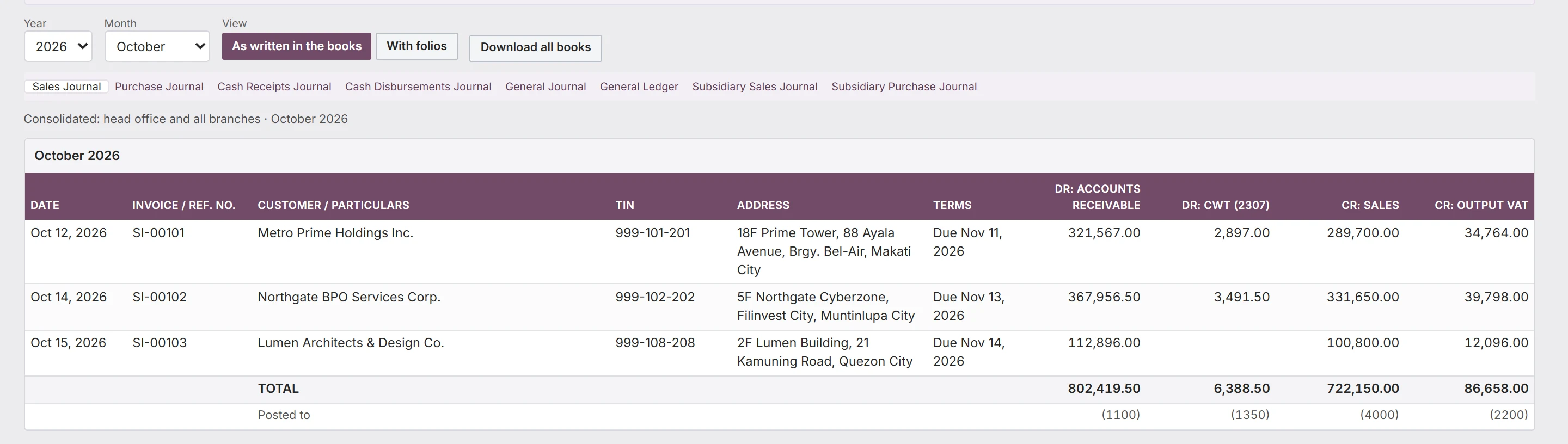
Sales Journal: invoices SI-00101 to SI-00103 on account. Sample records.
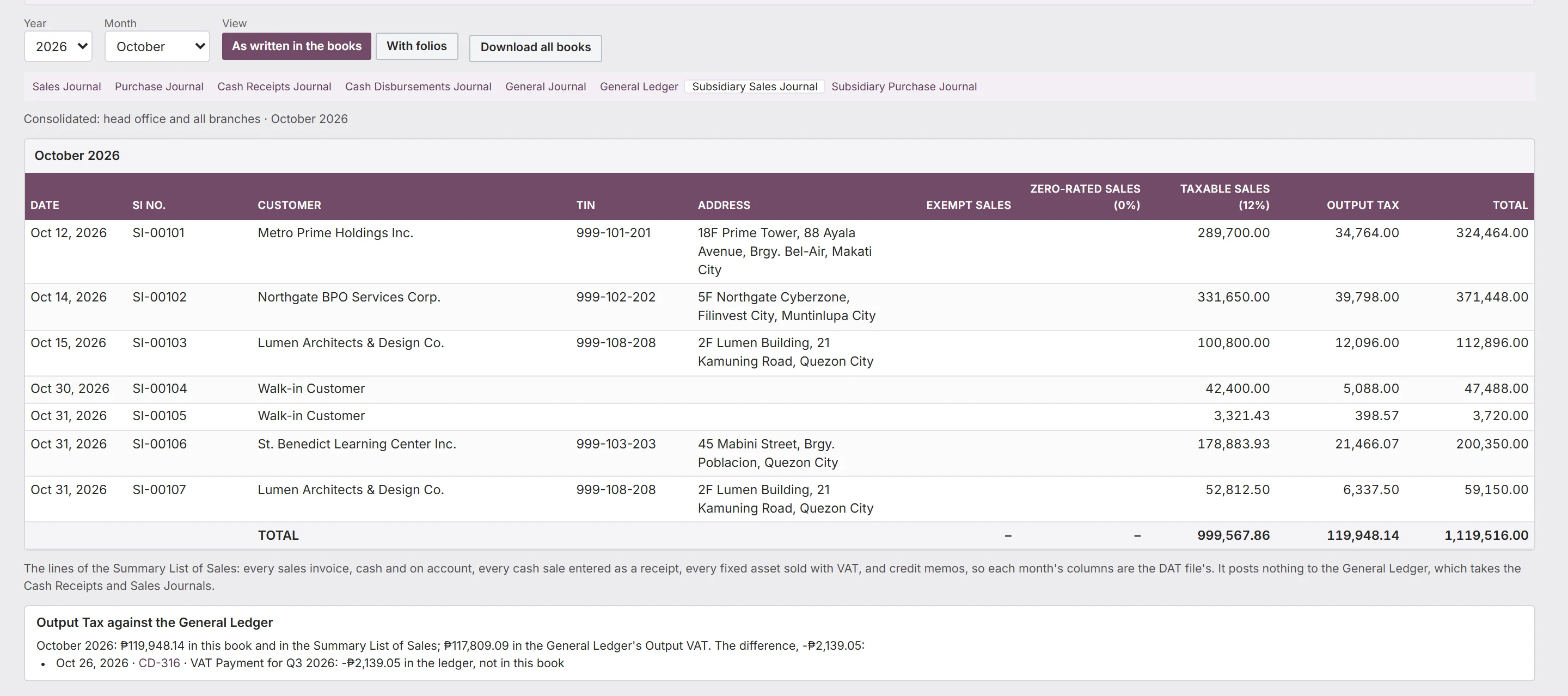
Subsidiary Sales Journal: all seven invoices, then the check of output tax against the General Ledger. Sample records.
| Gross | Output VAT | |
|---|---|---|
| Sales Journal (SI-00101 to SI-00103) | 808,808.00 | 86,658.00 |
| Cash Receipts Journal (SI-00104 to SI-00107) | 310,708.00 | 33,290.14 |
| Subsidiary Sales Journal (all seven) | 1,119,516.00 | 119,948.14 |
The Sales Journal's gross is its Accounts Receivable plus the tax its customers withheld (₱802,419.50 + ₱6,388.50). Sales were posted once, from the two journals; the SSJ agrees with them and posts nothing. Under the SSJ, the check of output tax against the General Ledger lists one item in the ledger and not in the book: the October 26 payment of the third quarter's VAT, which reduced Output VAT and is not a sale.
The one-question test
Ask: "What is the new economic event?"
- I sold something today → Sales or Revenue.
- A customer paid an old balance → Cash and Accounts Receivable, not a sale.
- I paid an old bill → Accounts Payable and Cash, not a purchase.
- I am copying detail from the SSJ, SJ or CRJ to the ledger → a posting, not a new transaction.
The reconciliation chains
- Sales: invoices → SSJ → SJ and CRJ → GL Sales and Output VAT → VAT return.
- Collections: collection receipts and deposits → CRJ → A/R ledger → GL Cash and A/R.
- Purchases: supplier invoices → SPJ → PJ and CDJ → A/P ledger → GL Inventory or Expense and Input VAT → VAT return.
How to register books of accounts with the BIR
Books are registered online through the BIR's Online Registration and Update System (ORUS) before you use them, and kept for five years. The steps depend on whether you keep manual, loose-leaf or computerized books.
- Online first. ORUS gives a QR code stamp for each registered set (RMC 3-2023). For manual and bound loose-leaf books it is affixed to the first page; for computerized books it is printed and kept with the records (RMC 91-2024).
- When, for manual books. A new business registers its manual books before the deadline of its first quarterly or annual income tax return, whichever comes first. A later set is registered before it is used. Manual books are not registered again every year: a set is used until its pages run out (RMC 3-2023).
- When, for loose-leaf and computerized books. These are registered every year, after the year ends (RMC 3-2023).
- Manual, loose-leaf or computerized. A new business may choose any of the three. One that chooses loose-leaf or computerized books does not need manual books in the meantime, but it secures the permit (loose-leaf) or the acknowledgment certificate (computerized) before use (RMC 65-2025).
- At the RDO only in limited cases. Registering any books over the counter is allowed only for an ORUS problem shown with proof, a taxpayer already at the RDO on the deadline day, or a senior citizen (RMC 91-2024). For permanently bound loose-leaf and computerized books, RMC 4-2026 (January 15, 2026) makes ORUS mandatory, with manual processing only on an official ORUS unavailability advisory or a screenshot of the system error.
- Loose-leaf books are printed under a Permit to Use (BIR Form 1900). The pages are bound within 15 days after the year ends and registered in ORUS within 15 days after the year ends, or after closing the business if earlier.
- Computerized books of accounts (CBA) are kept in a system covered by an Acknowledgment Certificate from the BIR. The soft copy of the year's books is submitted within 30 days after the year ends (RMO 9-2021), now through ORUS.
How long to keep the books
Five years, counted from the day after the deadline of the return for the year of the last entry, or from the actual filing if it was late (Section 235, as amended by RA 11976, Section 33). Manual and bound loose-leaf books are kept in hard copy; computerized books in electronic form (RR 7-2024, Section 4(A)(1)). The five years apply to computerized books too: the ten years in older rules (RR 5-2014) were overtaken by the EOPT Act. Keep the supporting invoices, receipts, vouchers and returns too, and keep everything longer if a protest, refund claim or other open tax case needs it.
Common bookkeeping mistakes
- Writing a cash sale in both the Sales Journal and the Cash Receipts Journal, both posting to Sales.
- Crediting Sales when a customer pays an invoice already recorded.
- Posting the SSJ total on top of the SJ and CRJ postings.
- A non-VAT business recording input VAT because a supplier's invoice shows VAT.
- Claiming input VAT from a receipt instead of a VAT invoice.
- Accruing 3% percentage tax for an individual on the 8% option.
- Leaving out cancelled invoice numbers, or skipping numbers in the booklet sequence.
- Charging equipment to expense, or a personal expense to the business.
- Correcting with correction fluid or tearing out pages of a handwritten book.
- Mixing branch transactions into the head office's books when the branch keeps its own.
- Posting adjustments straight to the ledger instead of through the General Journal.
- Writing the books only at year-end. The quarterly returns come from them.
How PXL Books keeps them
PXL Books is accounting software for internal use. It is not a BIR-accredited CAS, and it does not replace the books you registered unless your RDO has approved it as your loose-leaf or computerized books. It prepares the books from what you record and settles the posting-source question for you: each posted record is one entry in exactly one book, and only that book posts it to the General Ledger.
Every record goes to one book
| You record | VAT business | Non-VAT business | Folio |
|---|---|---|---|
| Cash sale | Cash Receipts Journal | Cash Receipts Journal | CR- |
| Sale on account | Sales Journal | General Journal | SJ- / GJ- |
| Collection from a customer | Cash Receipts Journal | Cash Receipts Journal | CR- |
| Cash purchase | Cash Disbursements Journal | Cash Disbursements Journal | CD- |
| Bill on account | Purchase Journal | General Journal | PJ- / GJ- |
| Payment to a supplier | Cash Disbursements Journal | Cash Disbursements Journal | CD- |
| Credit or debit memo, write-off, depreciation, payroll journal, your own journal entry | General Journal | General Journal | GJ- |
A collection credits Accounts Receivable, never Sales. Under Tax → Books of Accounts, a VAT business sees eight tabs (SJ, PJ, CRJ, CDJ, GJ, GL, SSJ, SPJ) and a non-VAT business four (CRJ, CDJ, GJ, GL).
The copy you write in your registered books
In the default internal mode, your registered books stay your official books and you write the same transactions in them. PXL Books shows each book As written in the books: no PXL folios, each month's column totals with the account each posts to, and the General Ledger posted from the journals by month.
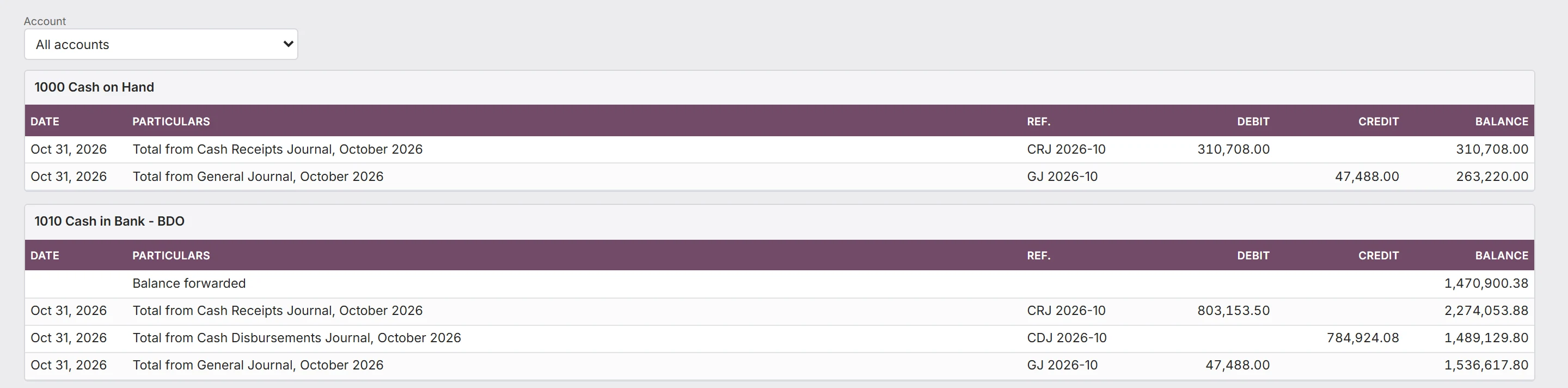
General Ledger posted from the journals by month: "Total from Cash Receipts Journal, October 2026", reference CRJ 2026-10. Sample records.
- Download all books saves the period's books in one zip, an Excel file per book, each titled "Copy to write in the registered book". Books with nothing posted are left out.
- With folios shows PXL's folios instead, each entry opening its record.
- A monthly reminder asks you to copy a month into your registered books, then lock it, so the two never differ.
The columns you would rule by hand
- Cash Receipts Journal: Dr Cash, CWT (2307); Cr Accounts Receivable, Sales, Exempt Sales, Zero-Rated Sales, Output VAT.
- Sales Journal: Dr Accounts Receivable, CWT (2307); Cr Sales, Exempt Sales, Zero-Rated Sales, Output VAT, with the customer's TIN, address and terms.
- Purchase Journal: Dr Inventory, Input VAT; Cr Accounts Payable, EWT Payable.
- Cash Disbursements Journal: Dr Accounts Payable, Inventory, Input VAT; Cr Cash, EWT Payable.
- Other accounts go to Sundry columns, or to columns of their own if you choose them. Each column holds one account, so two bank accounts get two columns. Empty columns are hidden.
- Every journal foots: under the table, PXL Books says whether total debits and credits agree.
SSJ and SPJ that tie to the cent
For a VAT business, the Subsidiary Sales and Purchase Journals list every invoice and bill with the counterparty's TIN and address, and the exempt, zero-rated and taxable amounts with the VAT each document posted. The rate in the headings comes from your Tax Rates.
- They post nothing. The note under each says so: the General Ledger takes the Cash Receipts and Sales Journals (or the Cash Disbursements and Purchase Journals).
- They read the same lines as the Summary List of Sales and Purchases, so each month's columns and each TIN's total agree with the DAT file you send to the BIR.
- The tie is on screen. Under each book, every month shows its output (or input) tax in the book and in the General Ledger, and either says They agree or lists the documents behind the difference. Downloading the DAT file warns you if the Summary List of Sales and the ledger's output VAT differ.
Cancelled numbers and voids
- A cancelled booklet number is one line marked CANCELLED, with no customer and no amount, in the book where its neighbours are. The sequence stays complete and no sale is invented.
- A sale voided on its own day becomes one CANCELLED line; its two postings cancel out, so the ledger has nothing from it.
- A sale voided on a later day keeps the original on its date and the reversal on the void date, both marked VOID.
- A posted entry is never edited in place. A change reverses the old lines and posts new ones, and System Notes keep the record's first values and every change with the date, time and user.
Books modes: internal, loose-leaf, CBA
Under Settings → Books → How the books are kept, the owner chooses one of three modes, from a date:
- Internal records (the default): your registered books stay your official books, and you write the same transactions in them from the copy above. Everything PXL Books keeps is for internal use.
- Loose-leaf books: enter your permit number (BIR Form 1900) and date. Once the year is locked, Print 2026's books makes one PDF: each book after a cover with your name, TIN, address, the book and period, the permit, the page count and a box for the BIR's stamp or the ORUS QR code, with the pages numbered through. Before the year is locked, the file is marked a draft not for binding.
- Computerized books of accounts (CBA): enter your acknowledgment certificate number and date. Once the year is locked, Soft copy of 2026 makes a folder of CSV files, one per book plus the trial balance, a manifest with each file's records, control totals and SHA-256 fingerprint, and a transmittal letter to sign.
A locked period keeps the mode it was kept in. Getting the permit or the acknowledgment is yours to do with your RDO; for CBA, PXL Books drafts the Annex C-1 and Annex E papers for your review. See Handwritten, loose-leaf and computerized books.
Branches
By default the head office's books carry every branch's entries. If a branch keeps its own books, tick them under Settings → Locations → Books kept at this branch: its entries take their own series (CR-MK-1, CR-MK-2 for a Marikina branch's cash receipts). A branch that keeps every book keeps its own General Ledger, with Due to and Due from Head Office lines that cancel out when consolidated. The copy to write and the year's print cover one set of books at a time.
Records after you stop
Books once kept as loose-leaf or CBA are never deleted. A business that closes becomes read-only and keeps its records for the years you set, at least five.
Try it
In the demo company, open Tax → Books of Accounts for October 2026. Compare the Sales Journal and the Cash Receipts Journal with the Subsidiary Sales Journal, then open the General Ledger to see each journal's total posted once. PXL Books is free until December 31, 2026.
Frequently asked questions
What are books of accounts?
The journals and ledgers in which a business records its transactions. Section 232(A) of the Tax Code requires a relevant and appropriate set of bookkeeping records; VAT taxpayers also keep the Subsidiary Sales and Purchase Journals.
How many books does a non-VAT business keep?
The law requires a relevant and appropriate set of records; it fixes no number of books. Most non-VAT businesses register four: General Journal, General Ledger, Cash Receipts Journal and Cash Disbursements Journal.
How many books does a VAT business keep?
Commonly six (GJ, GL, SJ, CRJ, PJ, CDJ) plus the Subsidiary Sales Journal and Subsidiary Purchase Journal that RR 7-2024 requires of VAT taxpayers.
What is the difference between a book of original entry and a book of final entry?
A book of original entry (a journal) records transactions by date from their source documents. The book of final entry (the General Ledger) collects the same amounts by account, with balances.
Is the SSJ the same as the Sales Journal?
No. The Sales Journal records sales on account in double entry and posts them. The SSJ is the detailed register of every VAT invoice, cash or credit, and posts nothing. A credit sale appears in both, but only the Sales Journal credits Sales.
Does a sale in the SSJ and the Cash Receipts Journal count twice?
No, as long as only one book posts it to the General Ledger. The other is a detail record that must agree with it.
Is collecting a receivable another sale?
No. The sale was recognized when the invoice was issued. The collection is Dr Cash, Cr Accounts Receivable, with no Sales and no new output VAT.
Do I register new books every year?
Not manual books: a registered set is used until its pages run out. A new set is registered before use.
How long do I keep the books?
Five years from the day after the deadline (or the actual filing) of the return for the year of the last entry, longer if a tax case is open.
Do software printouts automatically become registered books?
No. Their status depends on what you registered: handwritten books, a loose-leaf permit or computerized books.
Does PXL Books register my books with the BIR?
No. You register them through ORUS, or at your RDO where the rules allow. PXL Books prepares the books, the loose-leaf print and the computerized-books soft copy, and drafts the CBA papers for your review.
Which menu opens the books in PXL Books?
Tax → Books of Accounts.
Official BIR references
- National Internal Revenue Code of 1997 (RA 8424)
- RA 10963 (TRAIN law), Section 71: Section 232 as amended
- RA 11976 (Ease of Paying Taxes Act), Section 33: Section 235 as amended
- RR 7-2024: invoicing, registration and books under the EOPT Act
- RR 3-2024: VAT and percentage tax under the EOPT Act (BIR digest)
- RR 6-2026: creditable withholding tax on invoices
- RMC 112-2026: implementing RR 6-2026
- RMC 3-2023: online registration of books of accounts (BIR digest)
- RMC 4-2026: mandatory ORUS registration of loose-leaf and computerized books
- RMC 65-2025: books new registrants may choose (BIR digest)
- RMC 91-2024: when books may be registered at the RDO (BIR digest)
- RMO 9-2021: computerized books of accounts
- RMC 77-2024: invoicing thresholds
- RMC 68-2024: revised quarterly VAT return, 2550Q
- BIR media release on withholding tax on invoices
- BIR Form 1900: permit to use loose-leaf books
- BIR Form 2551Q guidelines
Related
- Books of accounts in PXL Books, feature by feature
- Handwritten, loose-leaf and computerized books
- How one record becomes your books, tax and FS
- Recording sales from your invoice booklet
- Quarterly VAT: 2550Q
- Percentage tax: 2551Q
- What PXL Books does not do
- Glossary
Last checked against the app: November 23, 2026. Tax rules: review with your accountant.