
EOPT in plain words: what changed for invoices and how PXL Books records them
The Ease of Paying Taxes Act (RA 11976) made the invoice the main document for goods and services. What it means for your sales, your books and your VAT.
On this page
The Ease of Paying Taxes (EOPT) Act, Republic Act No. 11976, took effect in January 2024. For invoicing, its main change is simple: the invoice is now the primary document for every sale, whether you sell goods or services. The official receipt is no longer the main document for services; it is supplementary. PXL Books records every sale as a Sales Invoice, for goods and services alike.
This page sums up the parts of EOPT that touch how a small business records its sales and purchases. It is a summary, not legal advice. For the details that apply to your business, read the law and its regulations, and check with your accountant.
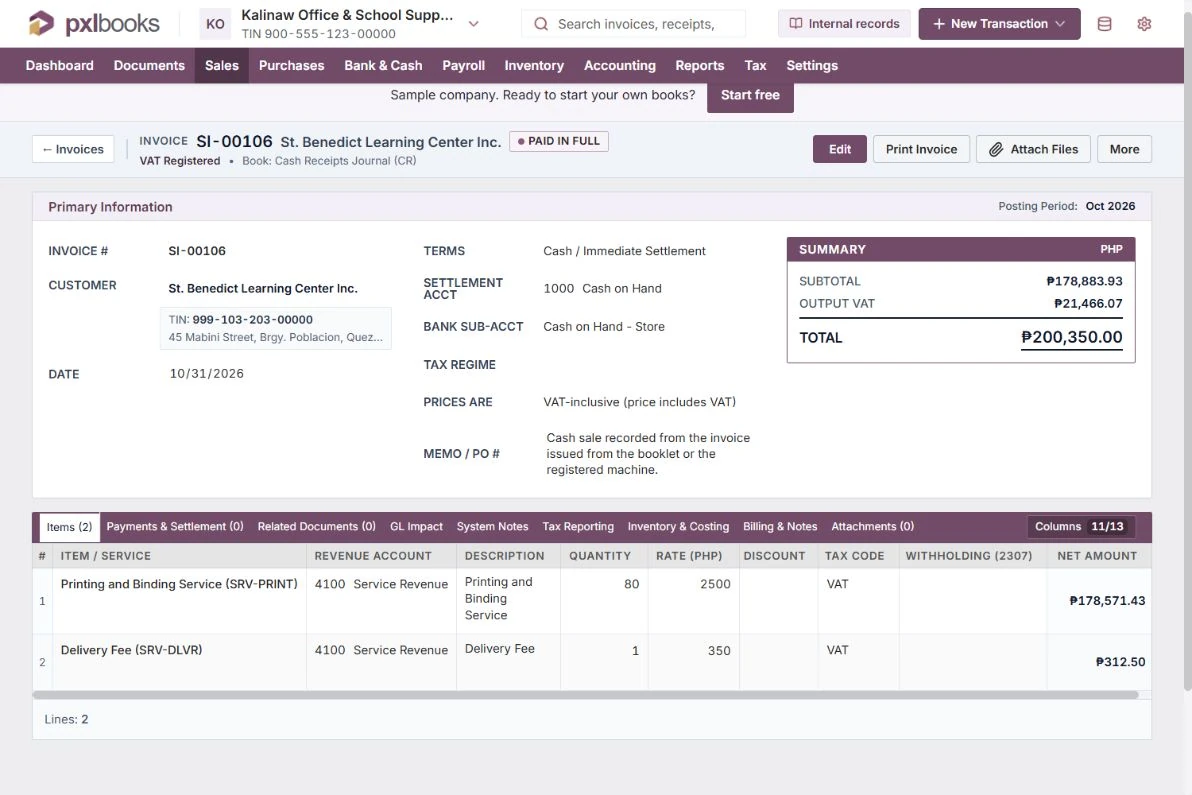
Product screenshot: demo sample records only.
Sources
- Republic Act No. 11976, the Ease of Paying Taxes Act, which amended the National Internal Revenue Code.
- Revenue Regulations No. 7-2024, on invoicing requirements under EOPT.
- RR 3-2024, on VAT and percentage-tax changes; RMC 77-2024, clarifying invoicing under RR 7-2024 as amended by RR 11-2024.
What changed
1. One document for goods and services: the invoice
Before EOPT, a seller of goods issued a sales invoice, and a seller of services issued an official receipt when paid. Now both issue an invoice. The official receipt became a supplementary document: you may still issue one for a payment, but it is not the document that supports the sale or the buyer's input VAT.
2. VAT on services follows the sale, not the collection
Before EOPT, VAT on services was based on gross receipts, so it was reported when the customer paid. Under EOPT, VAT on services is based on gross sales, like goods: it is reported when the sale is made and invoiced. A VAT business that sells services on account now reports output VAT on the invoice date, even before the customer pays.
3. Input VAT needs an invoice
A buyer supports its input VAT with the seller's invoice. A supplementary receipt alone does not support it.
4. Output VAT on receivables that stay uncollected
Because VAT now follows the sale, a seller may pay VAT on a sale it is never paid for. EOPT addresses this: a seller may deduct the output VAT on receivables that remain uncollected past the agreed term, under the conditions in the VAT regulations (Revenue Regulations No. 3-2024). The buyer, in turn, gives back the input VAT it claimed on that unpaid purchase. When the receivable is later collected, the VAT comes back.
5. Old receipts and booklets
EOPT and RR 7-2024 set out how a business uses up its unused official receipts and booklets printed before the change, for example as supplementary documents, or by converting them into invoices in the way the regulations describe. The details and deadlines are in the regulations and later BIR issuances. Ask your RDO or your accountant before you use old booklets.
6. Other changes
EOPT also classified taxpayers into micro, small, medium and large; allowed returns to be filed and taxes paid with any authorized agent bank, revenue collection officer or electronic channel; and changed other rules on filing and refunds. These do not change how you record a sale, so this page leaves them out.
How PXL Books follows EOPT
| EOPT rule | In PXL Books |
|---|---|
| The invoice is the primary document for goods and services | Every sale is recorded as a Sales Invoice, whether goods or services |
| VAT on services is based on the sale | Output VAT is recorded on the invoice date, whether the sale is cash or on account |
| Input VAT needs the seller's invoice | A bill records the supplier's invoice number; input VAT comes from the bill |
| Invoices come from registered booklets | You register your booklet's series in Settings → Company → Company & Tax Profile → Booklets, and each recorded sale carries its booklet number |
| Output VAT on receivables uncollected past their term may be deducted; the buyer gives back the input VAT | When EOPT uncollected VAT relief is enabled in Settings → Company → Company & Tax Profile, the supported VAT calculation takes out the output VAT on receivables past their term and keeps it in Deferred Output VAT on Uncollected Receivables until collected or written off. Review the separate buyer-side adjustment: input VAT on bills past their term goes to Deferred Input VAT on Unpaid Payables until paid |
| Collections may be supported by a receipt | A collection is recorded separately under Sales → Collections, linked to the invoice it pays |
PXL Books does not issue invoices or receipts to your customers. You issue them from your registered booklet; PXL Books records them. See Recording sales from your invoice booklet.
What this means for a small business
- Service businesses on VAT: your output VAT now follows your invoices. Record each invoice when you issue it, not when you are paid.
- Everyone: your invoice booklet is your sales record. Every number should be in your books, used or cancelled.
- Buyers: ask for an invoice, not just a receipt, for purchases where you claim input VAT.
- Bookkeepers: when you catch up a client's records, check which booklets were used after the change and how old ones were treated.
Common mistakes
- Waiting for payment to record a service sale in a VAT business. Under EOPT the invoice date sets the VAT.
- Claiming input VAT on a receipt that is not an invoice.
- Using old official receipts without checking the transition rules.
Try it
In the sales-entry demo, record a service sale on account with a VAT tax code, then open the VAT return for that quarter. The output VAT is there before any collection.
Illustrative service sale on account
A ₱11,200 ordinary VAT service invoice contains ₱10,000 service revenue and ₱1,200 output VAT. Recording the invoice and recording a later collection are separate events. Do not create a second sale for the collection. Any uncollected-receivable relief needs its statutory conditions and the opt-in product setting.
Questions
Is an official receipt the primary document for services?
Under EOPT, the invoice is the primary sales document; receipts are supplementary, subject to the applicable transition rules.
Does an overdue invoice automatically qualify for relief?
No. Review statutory conditions and the enabled EOPT relief setting before relying on the calculation.
Can PXL Books issue my legal customer invoice?
No. Record the invoice issued under your business’s own authority.
Can I use unused old receipts without checking?
No. Review RR 7-2024 as amended and later BIR clarifications before using or converting old stock.
Related
Last checked: November 20, 2026. This is a summary of the law, not legal or tax advice. Review with your accountant.