
Inventory: FIFO, weighted average and branch stock
Follow stock quantities and costs with FIFO or moving weighted average, stock cards, physical counts, NRV review and branch transfers.
On this page
PXL Books maintains perpetual quantities and values for tracked inventory. The configured costing method is FIFO or moving weighted average. Stock cards connect receipts, issues and adjustments to source records; location and branch filters explain where stock is held. Physical counts and valuation assumptions still need review.
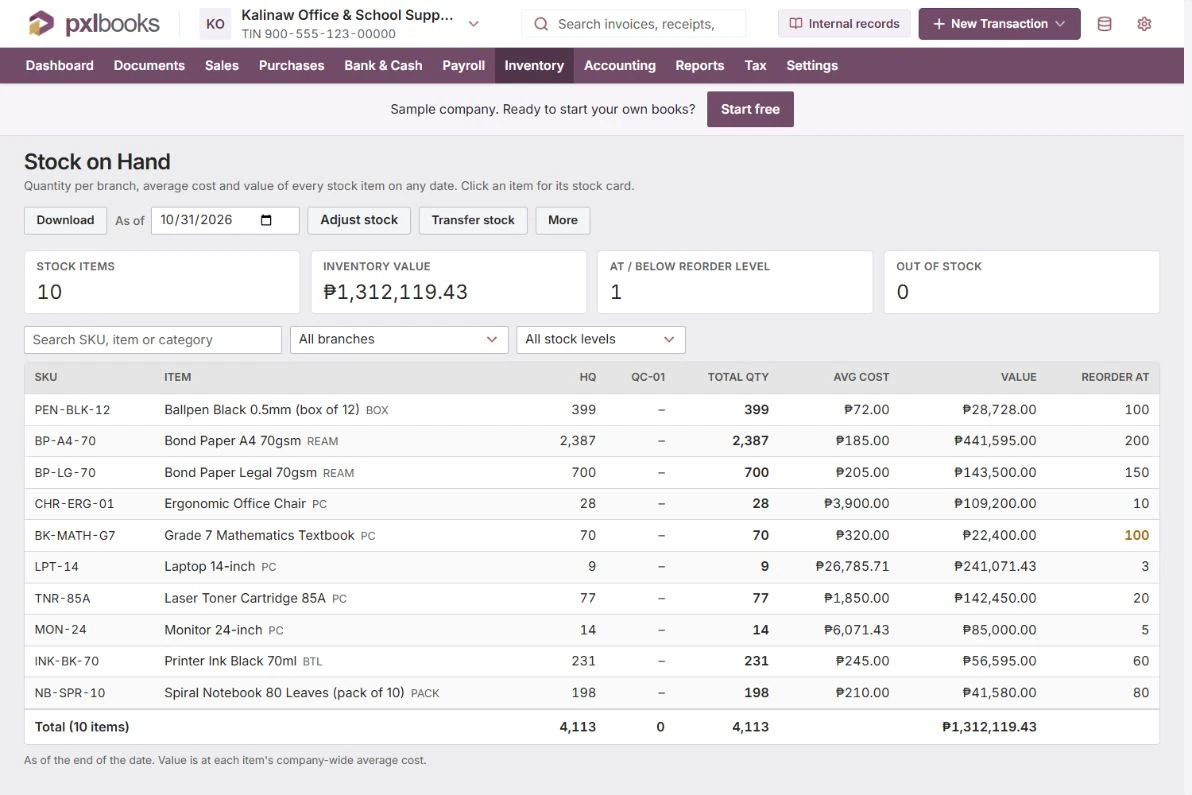
Product screenshot: demo sample records only.
FIFO and weighted average: an example
Buy 10 units at ₱100 and 10 at ₱120, then sell 12 units. With no other movements or charges:
| Method | Cost of the 12 units sold | Remaining 8 units |
|---|---|---|
| FIFO | 10 × ₱100 + 2 × ₱120 = ₱1,240 | ₱960 |
| Moving weighted average | 12 × ₱110 = ₱1,320 | ₱880 |
Both allocate the same ₱2,200 total purchase cost. Transaction order, opening values and extra costs matter. A method change is an accounting-policy decision, rather than a way to force a desired profit.
Follow stock to its source
- Maintain tracked items under Settings → Master Data → Items & Services.
- Confirm the method under Settings → Accounting Setup → Inventory Costing before posting movements.
- Record purchases, receipts, sales and deliveries with correct dates and locations.
- Review Inventory → Stock on Hand and Inventory → Stock Movements, then the item's stock card. Investigate unusual costs and negative quantities.
- Enter physical counts under Inventory → Stock Count and review the difference before posting.
- Review supported net realizable value adjustments under Inventory → Stock Revaluation, with evidence for the proposed selling price and completion or selling costs.
Transfer between branches
Use Inventory → Branch Transfers for source, destination, items and quantities. Check both locations. An internal movement within one business is different from a sale between legal entities.
Questions
Does stock on hand replace a physical count?
No. Count goods and investigate differences against recorded movements.
Which costing method is better?
Choose an appropriate policy with your accountant and apply it consistently. The example shows different timing of cost recognition.
Can I write stock down to an estimate?
The supported revaluation records a reviewed adjustment; estimates and treatment need supporting evidence.
Why is stock cost unexpected?
Check opening values, purchase prices, dates, returns, adjustments and the costing method.
Continue
Inventory features · Multi-branch accounting · Try the demo
Last checked against product source: November 20, 2026. Examples are illustrative; review your own records before posting or filing.