
BIR Form 2307: how to prepare it for many suppliers
What BIR Form 2307 is, who issues it and when, and how PXL Books fills it from your bills: each supplier, each month, the ATC and the tax withheld.
On this page
BIR Form 2307, the Certificate of Creditable Tax Withheld at Source, is what a business gives each supplier it withheld expanded withholding tax from. It shows the supplier's income payments for each month of the quarter and the tax withheld. In PXL Books, Form 2307 is filled from the bills you already recorded, so a business with many suppliers does not type each certificate by hand.
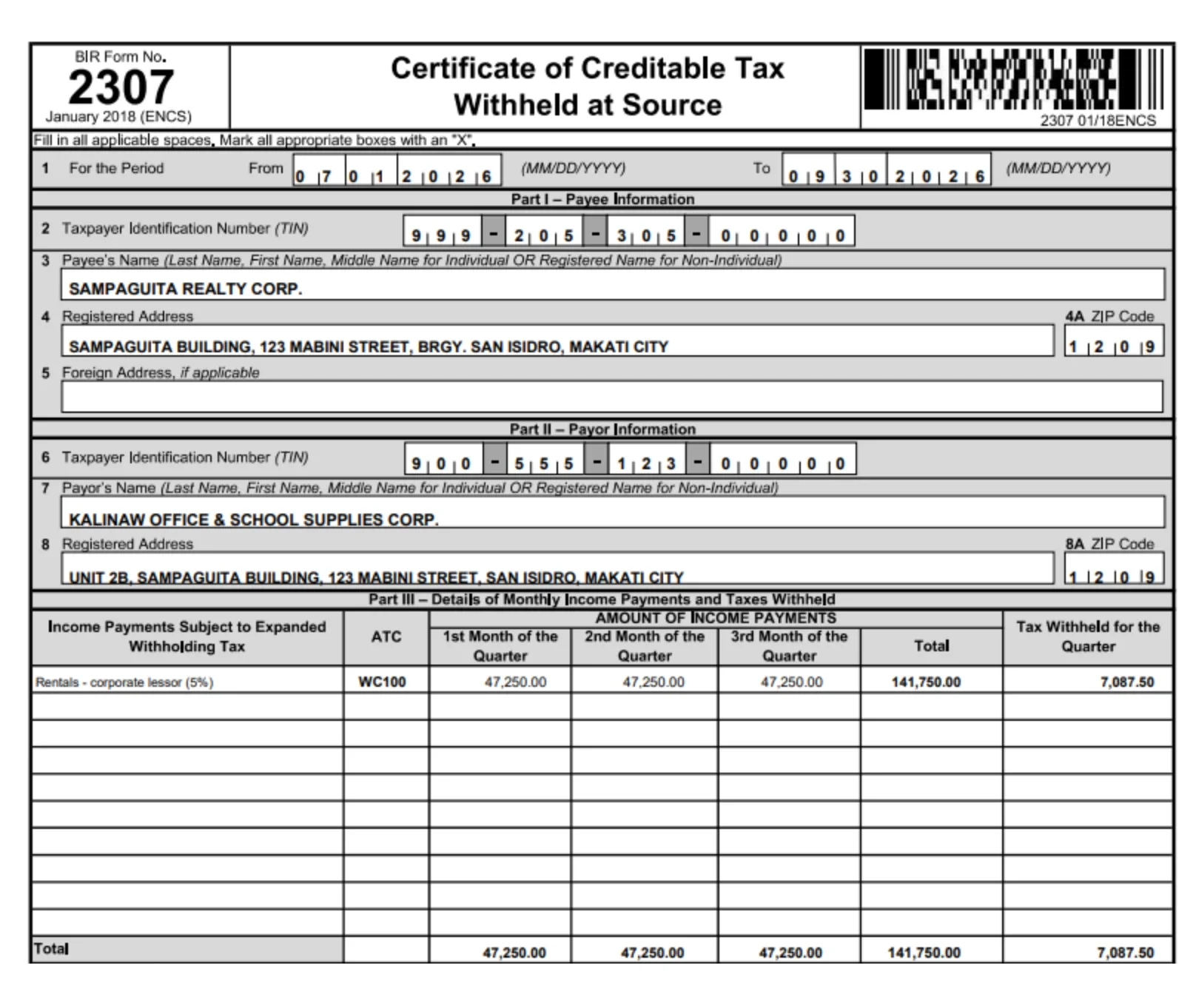
Demo records shown for illustration. Open the matching demo workflow to inspect the sample data.
What Form 2307 is
When your business pays a supplier for certain goods or services (rent, professional fees, contractors and others listed in the withholding regulations), it may be required to withhold a part of the payment as expanded withholding tax (EWT) and remit it to the BIR. Form 2307 is the certificate that proves the withholding:
- The payor (your business, the withholding agent) issues it.
- The payee (your supplier) uses it to claim the tax withheld as a credit against their own income tax.
- It covers one payee for one quarter, showing the income payments for each of the three months, the ATC (alphanumeric tax code) of each kind of payment, and the tax withheld.
When it is given
Under RR 11-2018, Section 5, the baseline is within 20 days from the close of the quarter, or simultaneously with the income payment when requested by the payee. Check subsequent applicable rules and prepare certificates early enough for review.
Where the figures come from
Each figure on a 2307 comes from a bill:
| On Form 2307 | From the bill |
|---|---|
| Payee's name, TIN and address | The supplier's record |
| Payor's name, TIN and address | Your business profile |
| Period | The quarter of the bill's date |
| Income payment for month 1, 2 or 3 | The bill's amount subject to withholding, in the month of its date |
| ATC | The withholding code on the bill line |
| Tax withheld | The expanded withholding on the bill |
Because the same bills feed your 0619-E monthly remittances, your 1601-EQ quarterly return and its Quarterly Alphalist of Payees (QAP), the 2307s you give your suppliers agree with what you report to the BIR.
How to prepare it in PXL Books
For one bill
- Record the supplier's bill with the withholding code (ATC) on the line. See How one record becomes your books, tax and FS.
- On the saved bill, click BIR 2307.
- Check the certificate. It shows the payee, the payor, the quarter, the month of the payment, the ATC and the tax withheld.
- Print it or download the PDF.
For several bills of the same supplier
- Open Purchases → Supplier Bills.
- Tick the supplier's bills for the quarter.
- Click Generate BIR 2307.
- PXL Books puts each bill in its month of the quarter and adds them, so the supplier gets one certificate for the quarter.
For every supplier of a quarter
- Open Tax → Withholding Tax → Expanded → Certificates Issued (2307).
- Choose the year and the quarter. The certificate opens on the first supplier you withheld from in that quarter.
- The payee list shows only the suppliers you withheld from in the quarter. Pick each in turn, check the certificate, then print it or download the PDF.
- Every certificate is for one supplier. To see all the quarter's payees together, use More → Export QAP (.DAT), the Quarterly Alphalist of Payees that goes with your 1601-EQ.
If tax was withheld on an entry with no supplier named, the screen says how much, since no certificate can show it. Name the supplier on that entry first.
Signing
You can upload an authorized e-signature once in the business profile. Later certificates can include that signature image. Confirm the signatory’s authority and review each certificate before delivering it.
Before you send it, check
- The supplier's TIN and registered name follow their Certificate of Registration (BIR Form 2303).
- The ATC matches the kind of payment.
- The quarter's total on all your 2307s agrees with your 1601-EQ and QAP.
- Every supplier you withheld from has a certificate. A missing 2307 means a supplier cannot claim the credit.
Common mistakes
- Withholding on the wrong base. EWT is computed on the amount the regulations specify, usually excluding VAT. Let the tax code on the bill do this.
- One certificate per bill when one per supplier per quarter is expected.
- Typing the 2307 by hand from a list that does not agree with the 1601-EQ.
- Old supplier names. If a supplier changed its registered name, update the supplier record first.
What PXL Books does and does not do here
PXL Books fills Form 2307 from your bills and gives you the PDF. You review it, sign it and give it to your supplier. Remitting the tax withheld and filing the 0619-E and 1601-EQ is done by you in eFPS or eBIRForms.
Try it
Open the demo company and see a filled Form 2307 for one of its suppliers, then open the bills it came from.
Worked withholding example
Assume ₱22,400 VAT-inclusive business rent: ₱20,000 rent plus ₱2,400 VAT. With an applicable 5% rental EWT code, the withholding is ₱1,000 and the supplier balance is ₱21,400. Review eligibility and ATC; WC100 is the corporate-payee rental example, not a code for every supplier.
Questions
When is Form 2307 furnished?
RR 11-2018 specifies within 20 days from quarter-end, or simultaneously with income payment when the payee requests it. Check applicable subsequent rules.
Does a 2307 prove remittance?
It certifies recorded withholding. Reconcile remittances and filing evidence separately.
Can several bills become one certificate?
Select the same supplier’s relevant posted bills for the quarter and review the generated monthly totals.
Does uploading a signature replace authorization?
No. Use a signature image only with the authorized signatory’s approval and review the final certificate.
Related
- How one record becomes your books, tax and FS
- Glossary: ATC, EWT, QAP and more
- What PXL Books does not do
Last checked against the app: November 22, 2026. Tax rules: review with your accountant.