
Financial statements and notes in the Philippines: a practical review
Understand the financial statements, notes, audit threshold, and tax disclosures, with a linked numerical example and a preparation checklist.
Educational guide. Examples state their assumptions; use the linked official sources to check the rules for your situation and filing period.
On this page
Financial statements explain the business’s position, performance, equity movements, and cash flows. Notes explain the policies and details behind the numbers. Generating these documents from accounting software does not create an independent audit opinion or establish compliance with every reporting requirement.
This guide explains preparation and review for a small Philippine business. The applicable financial-reporting framework, regulator, entity type, and filing obligations must be determined for the actual business. Do not assume that every small company uses the same PFRS framework.
What each statement answers
| Component | Question it helps answer | A useful reconciliation |
|---|---|---|
| Financial position | What does the business own and owe at the reporting date? | Assets = liabilities + equity |
| Income or comprehensive income | What did it earn and spend during the period? | Revenue less expenses to profit |
| Changes in equity | Why did owners’ interests change? | Opening equity plus movements to closing equity |
| Cash flows | Why did cash change? | Opening cash plus net cash movements to closing cash |
| Notes | What policies, estimates, and details explain the statements? | Each note agrees to the referenced figure |
The precise presentation and disclosures depend on the framework. This list is a review map, not a substitute for its requirements.
Worked example: keep the statements connected
Assume these closing balances, in pesos, for a simple illustrative business:
| Assets | Amount | Liabilities and equity | Amount |
|---|---|---|---|
| Cash | ₱100,000 | Trade payables | ₱250,000 |
| Trade receivables | ₱200,000 | Loan | ₱150,000 |
| Inventory | ₱300,000 | Equity | ₱600,000 |
| Property and equipment, net | ₱400,000 | ||
| Total | ₱1,000,000 | Total | ₱1,000,000 |
For the year, assume revenue of ₱1,200,000, cost of sales of ₱700,000, operating expenses of ₱300,000, and an illustrative tax expense of ₱40,000. Gross profit is ₱500,000; profit before tax is ₱200,000; profit after tax is ₱160,000. The tax figure is an assumption, not a demonstration that every business pays 20% of book profit.
If opening equity was ₱440,000 and there were no owner contributions, distributions, or other equity movements, closing equity is ₱440,000 + ₱160,000 = ₱600,000. That agrees to the financial-position example.
The ₱160,000 profit does not prove that cash increased by ₱160,000. Receivables, inventory, payables, loans, asset purchases, and noncash expenses affect the relationship. A cash-flow statement needs opening balances and transaction movements; closing balances alone are insufficient.
When is an independent audit required?
Section 232, as amended by TRAIN, Republic Act 10963, requires annual independent CPA examination for covered businesses exceeding ₱3 million in gross annual sales, earnings, receipts, or output. This is a statutory audit rule, not the same test as VAT registration, income-tax rate eligibility, or EOPT taxpayer-size classification.
Do not infer that being below this threshold removes every audit or financial-statement obligation. Corporate and sector regulators, lenders, owners, and contracts may impose additional requirements. Confirm those separately before preparing the filing package.
Notes and supplementary tax information serve different purposes
Accounting notes should explain the relevant reporting policies and supporting details, including material estimates and balances as required by the applicable framework. A generic template should be edited to match actual transactions; remove unsupported policies rather than presenting them as facts.
RR 15-2010 addresses supplementary tax information. The Auditing and Assurance Standards Council’s explanation distinguishes that information from disclosures required by PFRS. Ask the preparer and auditor how the applicable tax disclosures are presented; do not label the entire tax schedule a universal accounting-standard requirement.
Review checklist before sending the package
- Close and reconcile bank, receivables, payables, inventory, and fixed-asset balances.
- Review cutoff, depreciation, accruals, impairment, and tax adjustments as applicable.
- Tie every statement and note to the final trial balance and supporting schedules.
- Confirm opening equity, owner movements, and cash-flow classifications.
- Check the reporting framework, signatures, audit requirement, and current submission instructions.
- Retain the final version separately from working drafts and unresolved review comments.
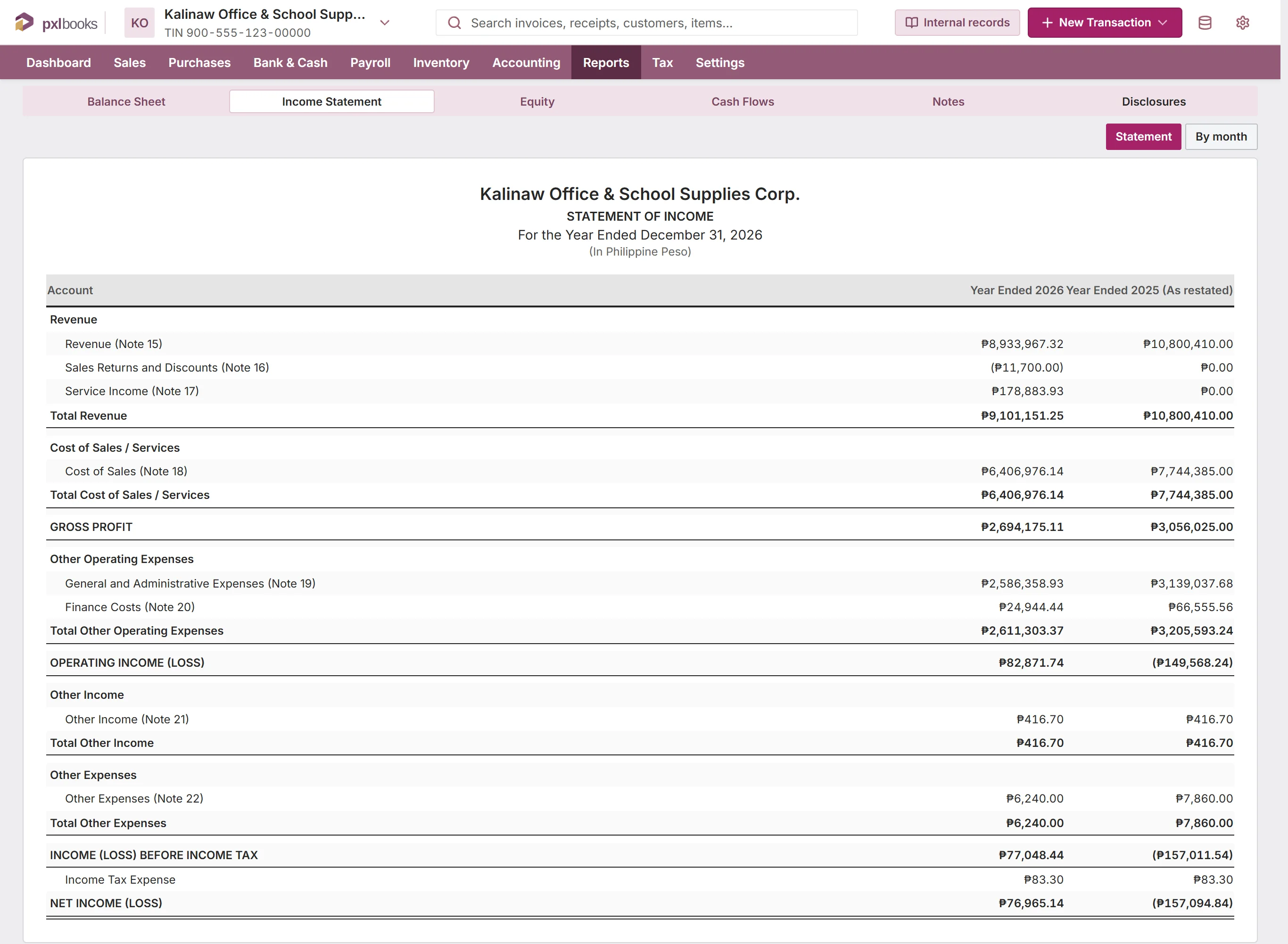
Use the PXL Books financial statements documentation for preparing and exporting statements and notes. Editable outputs are working documents for the preparer and auditor to review; the app does not perform the independent audit.
Last checked against official sources and the app: November 19, 2026.